12 Resume Mistakes That Are Costing You Interviews (And How to Fix Them)
Learn about 12 common resume mistakes that can reduce your chances of getting interviews and discover practical tips to make your resume more effective.

By Daniel Chen
Jun 22, 2026 · 5 min read
On this pageShowHide
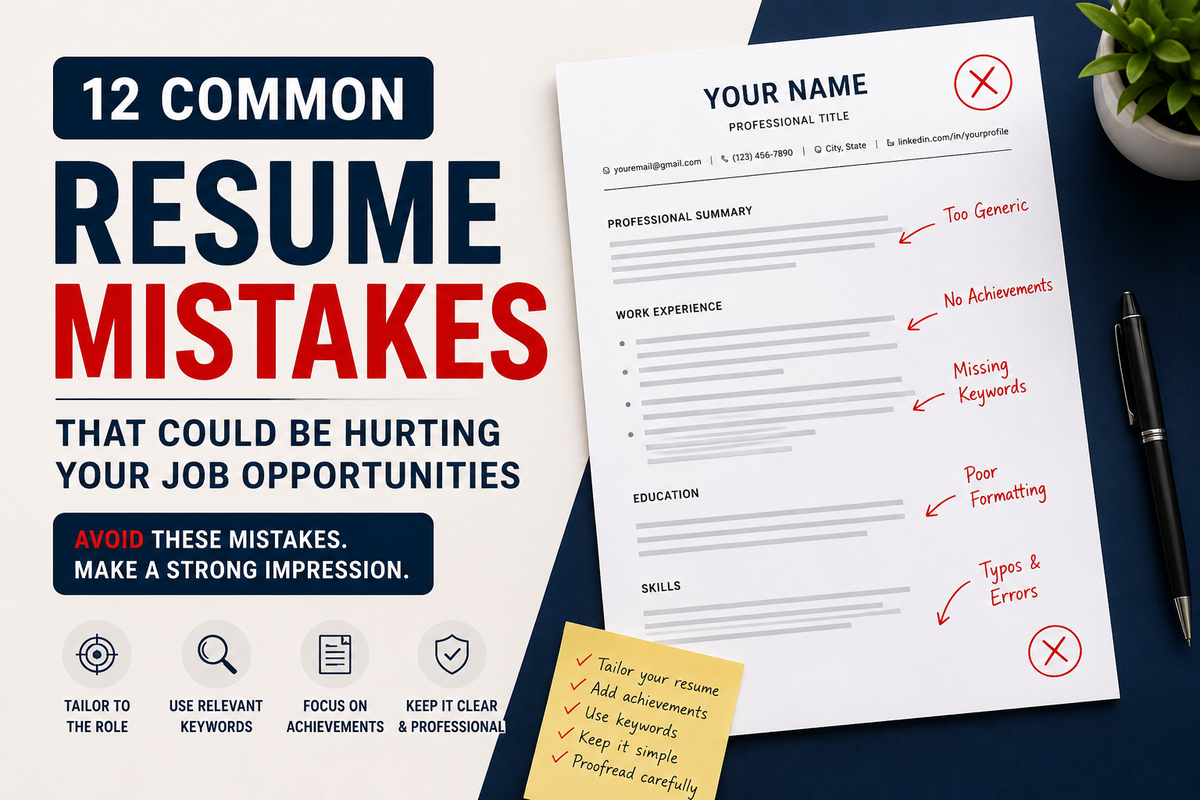
Your resume is often the first thing an employer sees when reviewing your job application. A well written resume can help you get interviews, while a poorly written one can reduce your chances of being considered for a role.
In this blog, we have listed 12 common resume mistakes and how you could possibly avoid them.
12 Resume Mistakes That Are Costing You Interviews (And How to Fix Them)
Here are 12 common resume mistakes and tips to help you avoid them.
1. Using the Same Resume for Every Application
Using the same resume for every application can make your qualifications appear less relevant to the role you're applying for.
While your experience may remain the same, the skills, qualifications, and responsibilities that employers prioritize can vary from one role to another.
A resume that works well for one position may appear less relevant for a different opportunity.
Tailoring your resume to each application can help demonstrate a stronger alignment with the role and make your qualifications more noticeable to recruiters.
How to Avoid It
Review the job description before applying and customize your resume to match the requirements of the role for each application.
2. Failing to Curate Your Resume to Your Targeted Role
Many job seekers try to showcase everything they have done throughout their careers.
While this may seem like a good idea, including unrelated information can make it harder for employers to see your specialization in the areas that matter most for the role.
Employers are often looking for candidates with specific skills, experience, and expertise, and a resume that covers too many unrelated areas may appear less focused. A targeted resume can help reinforce your suitability for the position.
How to Avoid It
Highlight experience, skills, and achievements that are relevant to the role you are applying for. This is also why you should not use same resume for every application.
3. Missing Important Keywords from the Job Description
Missing important keywords from a job description can reduce the chances of your resume being seen by a recruiter.
Many employers use Applicant Tracking Systems (ATS) to scan resumes for specific skills, qualifications, and job-related terms before they are reviewed by a person.
If your resume does not include the keywords employers are searching for, it may not appear as a strong match for the role, even if you have the necessary qualifications and experience.
How to Avoid It
Carefully read the job description and include important skills, tools, and qualifications where appropriate.
4. Focusing on Responsibilities Instead of Achievements
Listing only your responsibilities does not show employers the value you provided in previous roles.
While responsibilities explain what your job involved, they do not demonstrate the results you achieved or the impact of your work.
Employers are often looking for evidence that you can deliver results, solve problems, and contribute to a team.
Highlighting achievements can help showcase your abilities and make your experience more meaningful to recruiters reviewing your resume.
How to Avoid It
Include achievements and measurable results whenever possible.
Example:
Responsibility: Managed company social media accounts.
Achievement: Increased social media engagement by 40% within six months.
5. Overloading Your Resume with Information
Including too much information on your resume can make it harder for employers to identify the qualifications that matter most.
While it may be tempting to showcase every skill, project, and achievement, doing so can reduce the visibility of your strongest credentials.
Recruiters often spend only a limited amount of time reviewing each application, so a focused resume is usually more effective than one filled with unnecessary details. Prioritizing relevance can help your key qualifications stand out.
How to Avoid It
Keep your resume focused and relevant. Include information that supports your application and remove unnecessary details.
6. Listing Irrelevant or Outdated Skills
Listing irrelevant or outdated skills can make your resume appear less focused and draw attention away from the qualifications that are most important for the role.
Employers are typically looking for skills that align with their requirements, and including too many unrelated skills can make it harder for them to identify your areas of expertise.
A well curated skills section helps reinforce your suitability for the position and keeps the focus on your most relevant strengths.
How to Avoid It
Review your skills section regularly and remove skills that are outdated or unrelated to the role.
7. Creating a Short or Lengthy Resume
Creating a resume that is too short or too long can make it harder for employers to evaluate your qualifications.
A short resume may leave out important skills, experience, or achievements, while a lengthy resume can make it difficult for recruiters to identify the information that matters most.
In most cases, keeping your resume to a single page is a good goal, as it encourages you to focus on the most relevant information and present it in a clear, concise manner.
How to Avoid It
Include enough information to demonstrate your qualifications while keeping your resume concise and easy to review.
8. Using Weak Action Verbs
Using weak action verbs can make your experience appear less impactful than it actually is. Words such as "helped," "assisted," and "worked on" often fail to explain the scope of your contribution or the value you provided.
Employers want to understand what you accomplished, not just what you participated in. Stronger action verbs can make your achievements more specific, easier to understand, and more compelling to recruiters reviewing your resume.
How to Avoid It
Use stronger action verbs such as "led," "built," "created," "implemented," "improved," and "analyzed."
9. Listing Hobbies
Listing hobbies on your resume can take up valuable space that could be used to highlight your skills, experience, or achievements.
Since employers often spend only a short amount of time reviewing applications, every section should help demonstrate your qualifications for the role.
In most cases, hobbies provide little information about your ability to perform a job and may distract from the details that matter most to employers.
Unless a hobby is directly relevant to the position, it's usually best to leave it off your resume.
How to Avoid It
Only include hobbies if they demonstrate relevant skills or achievements related to the position.
10. Attaching a Photo
In general, it's best to avoid including a photo on your resume. For most roles, employers are primarily interested in your skills, experience, and qualifications, and photos can sometimes affect how Applicant Tracking Systems (ATS) process resumes.
There are some exceptions, however. In industries such as acting or modeling, including a photo may be expected as part of the application process. Before adding a photo, research whether it is a common practice in your industry.
If not, consider using a professional photo on your LinkedIn profile or personal website instead.
How to Avoid It
Unless an employer specifically requests a photo, or you're applying to an industry where resume photos are commonly expected, submit your resume without one.
11. Poor Formatting and Readability
Poor formatting can make it difficult for employers to quickly identify the information that matters most.
Large blocks of text, inconsistent spacing, and cluttered layouts can reduce the overall readability of your resume and make important details easier to overlook.
Since recruiters often review many applications in a short period of time, a well organized resume can help them navigate your experience more efficiently.
Clear formatting allows your skills, achievements, and qualifications to stand out more effectively.
How to Avoid It
Use clear headings, bullet points, consistent spacing, and readable fonts throughout your resume.
12. Including Spelling and Grammar Mistakes
Spelling and grammar mistakes can create a negative impression and suggest a lack of attention to detail.
Even small errors can affect the professionalism of your resume and make employers question the accuracy of the information provided.
Since your resume is often the first impression you make, presenting error-free content is important.
Taking the time to review your resume carefully can help ensure your qualifications are communicated clearly and professionally to potential employers.
How to Avoid It
Proofread your resume carefully before submitting it. Consider asking a friend or colleague to review it as well.
Put this advice into practice
Use JobPylot's AI resume builder, ATS checker, and template library to ship a stronger job application faster.
Daniel Chen
Engineering Hiring Manager
Daniel has run hundreds of technical interviews. He writes about signal, preparation, and how to stand out without gaming the system.
JobPylot Weekly
Get the next guide in your inbox
One practical career read when we publish. No fluff.